There’s a lot of noise online about camera sensors. Full‑frame is often treated as the “serious” choice, while smaller sensors get dismissed before anyone even looks at what they can actually do. But when you’re standing trackside in the rain, dust blowing across the stage, cars flying past at impossible speeds, the conversation changes completely. Out there, the Micro Four Thirds (M4/3) system shows strengths that full‑frame simply can’t match — and those strengths matter.
One of the biggest advantages becomes obvious the moment you pick up the .gear. Motorsport photography is all about reach, and on full‑frame that usually means carrying huge, heavy lenses.
A 600mm lens on a full‑frame body is a monster — expensive, tiring, and not something you want to run around with all day. On M4/3, a 300mm lens gives you the same field of view, but it’s small, light, and easy to handhold. I can move between corners, climb barriers, and shoot for hours without feeling like I’m dragging a gym bag around my neck. That freedom alone changes how you shoot.
Depth of field is another area where M4/3 quietly shines. People love to talk about full‑frame bokeh, but in motorsport, shallow depth of field can actually .work against you. When a car is drifting sideways, jumping, or coming straight toward you, you want the whole car sharp — not just the headlights. With M4/3, I get more depth of field at the same aperture, which means more keepers and more consistent sharpness. At f/2.8, I get the perfect balance: separation from the background, but enough depth to keep the wheels, body, and sponsor logos crisp. On full‑frame, the same shot often leaves half the car soft.
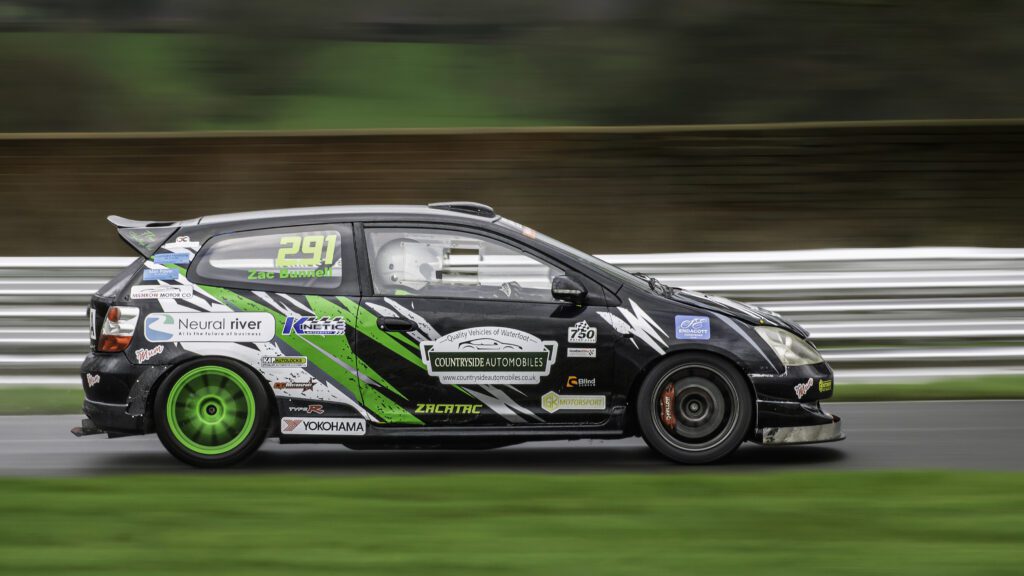
Stabilisation is another area where the smaller sensor makes a real difference. Micro Four Thirds bodies are known for their incredible IBIS, and it’s something I rely on constantly when shooting handheld in the paddock, service area, or during slower, atmospheric moments. It lets me shoot at slower shutter speeds without worrying about camera shake. But when I’m panning, it’s a different story. Panning is all about intentional horizontal movement, and IBIS tries to correct that movement. So for panning shots, I switch IBIS off — it gives me cleaner background streaks and sharper cars. This flexibility is one of the reasons the system works so well: stabilisation when you need it, freedom when you don’t.
Another advantage that’s easy to overlook is sensor readout speed. Motorsport is full of fast, unpredictable motion — spinning wheels, sudden direction changes, cars sliding through smoke. A smaller sensor reads out faster, which means less rolling shutter and fewer distortions. Full‑frame sensors, simply because they’re larger, take longer to read, and that can lead to skewed wheels or stretched shapes during fast pans. With M4/3, those issues are far less common, and the autofocus benefits from the faster readout too.
.
Then there’s durability. Motorsport is not a controlled environment. It’s rain, dust, gravel, mud, heat, cold — sometimes all in the same day. M4/3 bodies like the OM‑3 are incredibly tough and weather‑sealed, and because the lenses are smaller, the whole system is easier to protect. Full‑frame bodies can be weather‑sealed too, but the big lenses are the weak point. When I’m shooting rally stages in the rain. I trust my M4/3 gear completely.
Finally, the smaller sensor allows for faster burst rates, deeper buffers, and clever features like Pro Capture and vehicle detection autofocus. These aren’t gimmicks — they’re genuinely useful tools when you’re trying to catch a jump, a drift initiation, or a split‑second moment of action. Full‑frame cameras have high burst rates too, but the combination of fast readout, lightweight shutter, and smart software gives M4/3 a real edge in motorsport.
When you put all of this together, the picture becomes clear. Micro Four Thirds offers longer reach without the weight, more depth of field for fast subjects, better stabilisation for handheld shooting, the option to disable IBIS for panning, less rolling shutter, tougher and lighter gear, and fast, intelligent shooting features — all at a lower cost. Full‑frame has its strengths, especially in low light and dynamic range, but for motorsport, the practical advantages of M4/3 matter more.
For me, the Micro Four Thirds system isn’t about winning a spec sheet comparison. It’s about what happens trackside, in real conditions, with real challenges. It gives me reach, speed, stability, reliability, and consistency — and most importantly, it helps me capture the emotion and energy of racing without fighting my gear. That’s why I choose M4/3. Not because it’s smaller, but because it’s smarter for the sport I shoot.